
Part 2: Communicative competence at school
When we adopt the CCRA, we must treat communicative competence as social and relational knowledge, moving beyond the traditional notion of “competence” as the ability to follow a set of purely linguistic rules.
In other words, what matters in communicative competence is the ability to draw upon and combine a varied repertoire of communicative resources depending on the situation, the interlocutors, and the social practices involved. This view emphasizes how people select, expand, or interweave different elements of their repertoire to construct meaning and connections with others.
Developing communicative competence in an educational setting requires attention not only to grammar and vocabulary, but also to the richness and flexibility of students’ communicative repertoire as it emerges in real-life classroom and school contexts.
Let’s activate our CCRA:
critical communicative repertoire awareness
Let’s imagine ourselves in a middle school. The boys and girls are about 11 years old and are in an important stage of development between childhood and adolescence. School life in middle school is certainly very different from that in elementary school, and they are still developing their communication skills in this new setting. This applies to everyone, but especially to students who have recently arrived from another country or a different cultural background.
In fact, you often hear teachers making explicit comments such as:
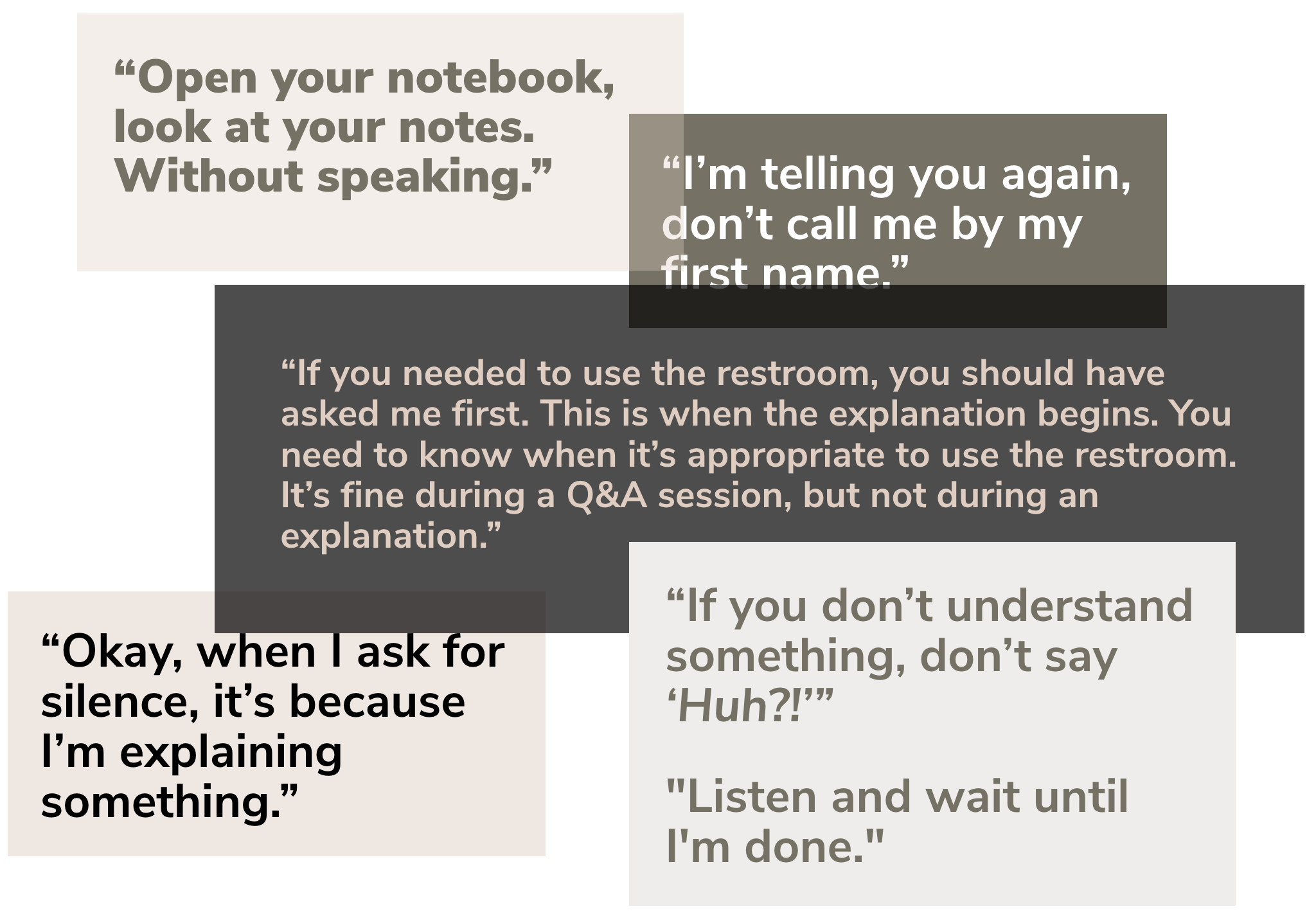
Reading these comments might even make us laugh:
Isn't it obvious that when I want to speak, I ask for silence?
Isn't it obvious that a teenager should address the teacher formally?
Isn't it obvious that you need silence to study your notes carefully?
The answer is simply: No, it’s not obvious! These norms seem completely natural to us, but they are cultural and ideological.
Just as we adults learned these rules long ago, our students must learn them as well. Even these seemingly trivial aspects of communication skills in school should be examined critically and regarded as new elements of the communicative repertoire —not just for newly arrived students, but for everyone.