Part 2: Communicative competence at school
So far, we have discussed two key concepts:
The communicative repertoire: the totality of all the means we have for communicating—languages, linguistic systems, and other non-linguistic modes of expression—which coexist in a non-hierarchical manner within the individual.
Critical multilingual awareness: a close look or a critical eye toward languages, linguistic systems, and their roles in society, with the aim of understanding why we consider these roles ‘normal’ and ‘natural’ (or not).
…and we’re getting closer to the CCRA: critical communicative repertoire awareness.
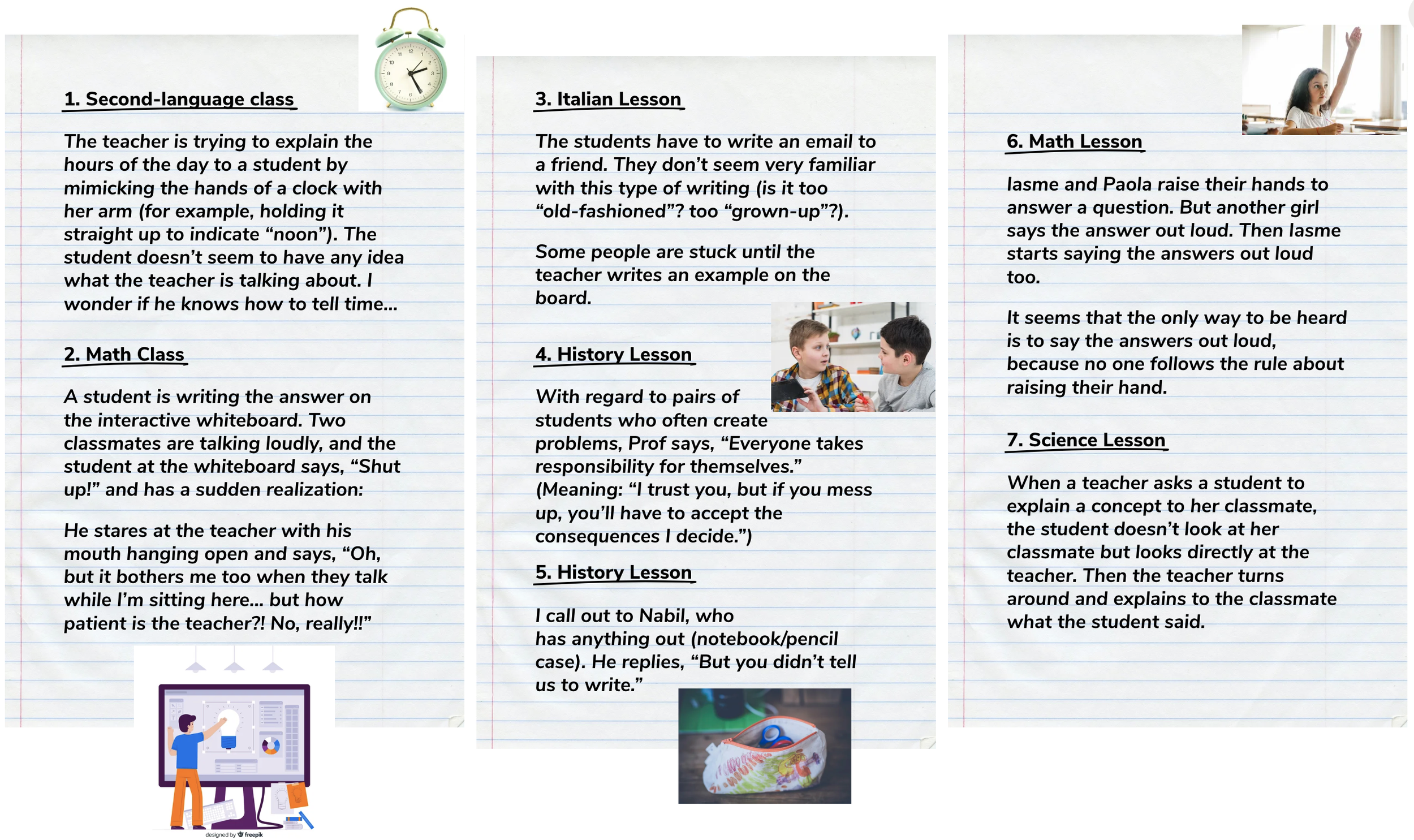
But first, let’s add a third key concept: communicative competence. Below are the slides explaining this concept, which can also be downloaded and used in class.
-
In each of these examples, we found:
misunderstandings between teachers and students (e.g., #1)
moments of shared understanding between teachers and students (e.g., #2, #4)
moments of apparent “incompetence” in communication (e.g., #3, #5)
instances where communicative competence is demonstrated (e.g., #6, #7)
-
Sometimes yes, and sometimes no.
In #6, we see that the usual rule of raising your hand and waiting to be called on doesn’t “work.” Giving the teacher the answer out loud without raising your hand would normally be a deviation from the rule, but Iasme shows that she understands this rule and therefore decides—instead of remaining silent with her hand raised—to make herself heard.
In #7, we see a student who reads very carefully “between the lines”: she perhaps senses that the teacher’s request (to explain a concept to her classmate who was absent) is actually a sort of assessment of her knowledge. She therefore gives the teacher an answer in a format more befitting a test than an explanation to a classmate. -
In each excerpt, we see different elements:
RC: foreign language (in this case, German) + body language; CC: trying to use body language to facilitate vocabulary development in German (this time, without success!)
RC: writing/speaking at the blackboard; CC: realizes that it’s hard to speak from behind the teacher’s desk when the whole class is talking.
RC: the skill of writing (mock) emails; CC: knowing how to ask for an example or template to use as a basis for writing them.
RC: talking during class; CC: knowing how to behave so as not to upset the teacher.
RC: take notes; CC: be aware that lectures require note-taking.
RC: body language; CC: recognizing that there is a deviation from the usual routine and adapting.
RC: “Academic Italian”: CC: Recognize that the professor wants to assess your knowledge of a topic.
-
Hymes, Dell. (1972). On communicative competence. In J. B. Pride & J. Holmes (Eds.), Sociolinguistics: Selected Readings. Penguin.
See also:
Balboni, Paolo. (2022). La Natura Della Competenza Comunicativa. SAIL, https://doi.org/10.30687/978-88-6969-607-7/005.
Zorzi, Daniela. (1996). Dalla competenza comunicativa alla competenza comunicativa interculturale. Babylonia, 2, pp. 46-52. https://www.itals.it/alias/dalla-competenza-comunicativa-alla-competenza-comunicativa-interculturale
Let’s consider, from the perspective of communicative competence, a few observations from the first semester of the STEMCo Project.
The STEMCo team observed over 400 hours of middle school classes in the Veneto region and South Tyrol. During our observations, we took notes on classroom interactions, always paying close attention to rituals, traditions, and things taken for granted. Here are some of our notes from the period between September and November 2022.